Category: Healthy and comfortable homes

Explore how thoughtful design improves comfort, health and wellbeing through daylight, ventilation, materials and spaces that support everyday living.

  • Hempcrete: Plastic-free walls for Plastic Free July

    Hempcrete: Plastic-free walls for Plastic Free July

    Every July, millions of people take part in Plastic Free July, looking at ways to reduce plastic waste in their homes and daily lives. It is an important reminder that our choices matter, but in the world of building design, plastic can be harder to spot.

    Close-up of a pressed straw bale, showing a dense, textured surface made of compressed straw pieces in yellow and brown—an ideal inspiration for plastic-free walls during Plastic Free July, with natural fibres tightly packed together.

    Hempcrete wall close up

    When we think of reducing plastic waste, we often start with straws, packaging, or shopping bags. But the built environment, particularly how we construct our homes, is one of the largest and least visible contributors to plastic use.

    In most modern houses, plastic membranes, synthetic insulation wraps, and petrochemical sealants are hidden behind every finished surface. They are there to manage moisture and protect insulation, but they’re not without cost. These materials are energy-intensive to produce, hard to recycle, and often compromise indoor air quality.

    This Plastic Free July, we are spotlighting a different approach: building with hempcrete, a breathable, carbon-storing, and plastic-free wall system that supports healthy, sustainable homes.

    What Is hempcrete?

    Hempcrete is a natural building material made from hemp hurd (the woody core of the hemp plant), lime binder, and water. It’s mixed on site and cast in place around a timber frame, where it cures into a light yet solid insulating mass.

    Unlike synthetic wall systems, hempcrete is vapour-permeable, meaning it allows moisture to move through it without trapping condensation. It also offers high thermal mass, acoustic insulation, fire resistance, and natural pest resistance, all without the need for plastic vapour barriers.

    See our other blogs about hempcrete construction: Hands-on with Hempcrete and Hemp: Houses that breathe so you can too.

    Plastic-free construction, by design

    In most conventional homes, plastic wraps are used to manage moisture and improve thermal performance. But these materials are not biodegradable, and over time they can degrade, tear, or contribute to poor air quality inside the home.

    With hempcrete, we do not need synthetic barriers. The material naturally balances humidity and temperature, creating a stable and comfortable indoor environment.

    A large black rectangular container is filled with light brown shredded or ground material, possibly hempcrete or woodchips, with two small metal pipes attached to one side near the bottom—ideal for plastic-free walls this Plastic Free July.
    Wearing gloves and a blue hoodie, a man empties hempcrete—a sand-like material for plastic-free walls—into a black container on wheels, likely at a construction or work site.
    Close-up of a wall made from compressed straw or hempcrete, showing its rough, fibrous texture and unfinished window opening with sunlight casting shadows—an inspiring example of plastic-free walls for Plastic Free July.
    A construction site with unfinished hempcrete walls, two yellow saw horses, a wooden ladder, and building materials scattered on the floor. Sunlight filters in through an open window—a step towards plastic-free walls for Plastic Free July.
    A partially constructed building wall with timber framing and a section covered in light-coloured hempcrete render, showcasing plastic-free walls. Sunlight and trees are visible in the background, reflecting the spirit of Plastic Free July.

    Photo from a site visit of one of our residential projects in Hillwood, Tasmania built using hempcrete.

    On a recent project here in Lutruwita/Tasmania, we used a wall system that eliminates plastic membranes altogether, relying instead on the intelligent moisture buffering of hempcrete walls. The result? A low-tox, low-waste, high-performance envelope that breathes.

    Sustainable building starts with materials

    At Inwardout Studio, we believe good design is about more than just aesthetics. It is about systems that respect the environment, and the people who live in them.

    Hempcrete ticks many of the boxes we care about:

    • Made from renewable, regenerative resources
    • Sequesters carbon during growth and curing
    • Fully compostable or recyclable at end of life
    • Naturally insulates without the need for petrochemical foams
    • Reduces construction waste by simplifying the wall system

    Every material choice sends ripples far beyond the building site. Choosing natural building materials like hempcrete is notjust about reducing waste, it’s about creating homes that support well-being, biodiversity, and climate resilience.

    Let’s build differently

    This Plastic Free July, take a closer look at the materials behind your walls. Could hempcrete be part of your next renovation or new build?

    We are always happy to chat about low-impact design, healthy materials, and how to make your home more future-friendly.

    Got questions about hempcrete? Drop us an email, we would love to hear what you are planning.

    #PlasticFreeJuly #Hempcrete #NaturalBuilding #LowToxHome #SustainableDesign #PlasticFreeBuilding #BreathableHomes #TasmanianArchitecture #CarbonSmartMaterials #HealthyHomesAustralia #BuildingDesign #BuildingDesigner #NorthernTasmania #Tasmania

  • Hemp: Houses that breathe so you can too

    Hemp: Houses that breathe so you can too

    Why should you construct your next home out of hempcrete? And how can Inwardout Studio help you to do that?

    As a building designer, I am always looking for ways to create beautiful, functional and sustainable spaces for our clients. That is why I was intrigued by the idea of using hempcrete for one of our upcoming projects. Read on to learn about my experience using this building material in our design practice, and to find out how it could benefit your build too.

    What is hempcrete?

    Hempcrete is a natural composite made of hemp hurd (the woody core of the hemp plant), lime binder and water. Hemp has many advantages over conventional materials as it is:

    • Carbon negative, meaning it absorbs more carbon dioxide than it emits during its life cycle,
    • Fire resistant, termite resistant and mould resistant,
    • Breathable, allowing moisture to escape and preventing condensation and dampness,
    • Durable, flexible and recyclable, and
    • Possesses excellent thermal and acoustic insulation properties, creating a comfortable and healthy indoor environment.
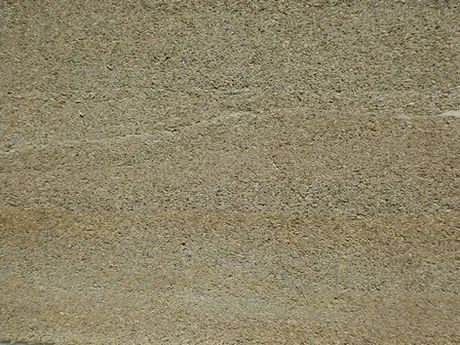
    A close-up view of a rough, textured beige hempcrete wall surface, showing subtle horizontal lines and variations in colour and texture.
    A close-up view of a rough, textured beige hempcrete wall surface, showing subtle horizontal lines and variations in colour and texture.

    Hempcrete wall close up, showing the hemp finish.

    Hempcrete has been used for thousands of years in various countries. However, the use of hemp is still relatively new in Australia. However, I believe it has great potential to become a mainstream building material in the future, especially as we face the challenges of climate change and resource depletion.

    How did I discover hempcrete?

    I first learned about hempcrete when I was working on a garden design project for a hempcrete house in Westbury, Tasmania. The owners of the house, Sean and Mandy, are a couple who are passionate about sharing their experience of building their own eco-friendly home.

    I was inspired by Sean and Mandy’s story and decided to learn more about hempcrete. I helped Sean on a working bee one afternoon, mixing and temping the hemp for the house walls, which proved to be an invaluable learning experience.

    A construction worker in an orange safety vest kneels on the floor of a partially built, sustainable building. Nearby are bags of materials, buckets, a workbench, and a yellow cement mixer inside the unfinished structure.
    Two metal ladders stand inside a partially constructed, sustainable building with exposed ceiling beams and an unfinished wall. A window opening lets in light, and a shop vacuum rests on the dusty floor—an early stage of creating breathable homes.

    At Sean and Mandy’s house during the hempcrete wall working bee .

    This home’s beauty and simplicity continues to inspire me. The hempcrete walls have a natural texture and colour that blends in so well with the surrounding landscape. The house is warm in winter and cool in summer.

    If you would like to know more about Sean and Mandy’s house-building journey, read their blog. Or visit the house yourself! This couple organise regular eco-tours of their house and garden (the latter which we designed!).

    The Campbell Town Hemp House

    That is why I am excited when I was offered the opportunity to design a hempcrete house for one of my clients in Tasmania. The project is a new build on a rural property. The clients want to create a modern and energy-efficient home that will blend in with the natural surroundings and reflect their commitment to environmental sustainability.

    A modern, single-storey hemp house with a metal roof and solar panel windows in a rural setting, featuring a small porch, outdoor chairs, a water tank, and surrounded by grass under a clear blue sky—perfect for healthy living.
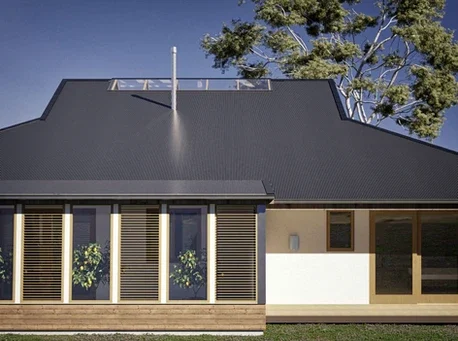
    Modern house with a dark sloped metal roof, large windows with wooden shutters, and a light timber exterior. Designed as a breathable home, it sits beneath a clear blue sky with a tall tree partially visible behind the house.

    3D renders of our design showing the eastern facade (left), and the northern facade with the sun room (right).

    This design includes the following features:

    • Combination of timber framing and hempcrete infill for the walls to provide beautiful finishes
    • Single-storey layout with fully accessible visitor accommodation
    • Charging spot for electric vehicles
    • Central living area with an indoor garden to bring nature inside
    • Masonry heater place in the centre of the house for a consistent heat during winter
    • Sunroom along the north facade to provide solar gain in winter, with louvres to let the air flow into the house during summer
    • North-facing orientation to maximize solar access and natural light
    • Sloped roof with skylights to enhance ventilation and daylighting
    • Timber floor finish on timber batten for more flexibility (and they feel much better on your knees!)
    • Concrete slab to provide thermal mass, laid over pods made of recycled plastic (much better than the polystyrene ones)
    • Rainwater tank for water supply to the house and veggie garden

    NB. The existing shed on this property was recently updated to include solar panels to provide for this household’s electricity needs.

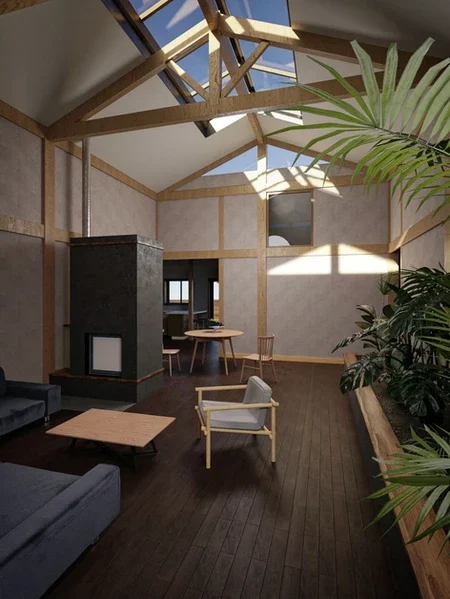
    Modern living room with high ceilings, skylights, exposed wooden beams, dark wood floors, a fireplace, minimalist furniture, and large indoor plants along one wall—perfect for those who appreciate sustainable building and breathable homes.
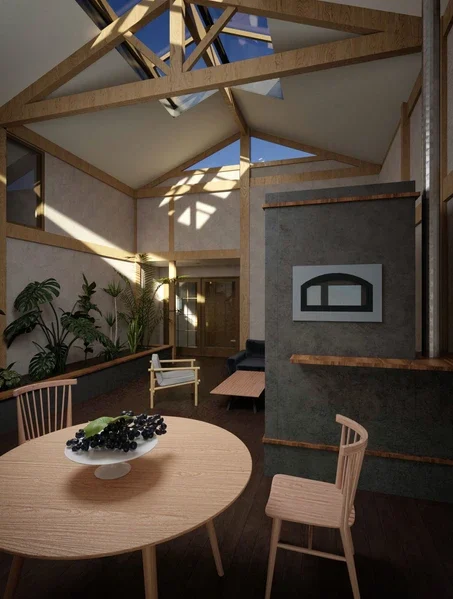
    A modern, sunlit living and dining area with wooden beams, large windows, skylights, plants, a wooden table with chairs, a bowl of grapes, and minimalist furniture—showcasing the beauty of sustainable construction and breathable homes.

    3D renders of the centre space showing the masonry heater and the indoor garden.

    Wall Composition: In this project, the wall composition is 90mm of hempcrete on one side, a 90mm timber stud in the middle, and another 90mm of hempcrete on the other side. There is a 10 mm lime render in the outside and inside. It is very important to use a breathable finish for the hemp wall. This design provides both insulation and structural support. The R value of this wall is R3.0.

    Challenges and rewards of designing a hempcrete house?

    Designing a hempcrete house is a rewarding experience for me. I am learning a lot about this innovative material and how to use it effectively. I also enjoy collaborating with the clients, the builder, the Hemp Masonry Company, and other professionals involved in this project. We are lucky here in Tasmania to have a company which grows and processes the hemp for construction, X-Hemp is one of only a small handful of cannabis fibre processing mills operating in Australia, and they claim to be the only 100% female-owned and run hemp facility in the world.

    Designing a hempcrete house also had some challenges. One of them was finding suitable contractors who were familiar with hempcrete construction. Hempcrete is still a relatively new material in Australia, so not many builders have experience working with it. Fortunately, I work closely with an experienced builder in hemp building for this project. Another challenge is dealing with the regulations and approvals for building with hempcrete. Hempcrete is not yet recognised as a standard building material in Australia, so it requires special performance solutions. This can cause delays and extra costs for any project. At this stage, I am still in the process of gaining building approval to ensure compliance with the relevant codes and standards. I will keep you informed of further developments in this space.

    Future plans for designing with hempcrete?

    Designing a hempcrete house is an exciting journey for me. I am proud of the outcome and happy with the feedback from the client. I think hempcrete is an amazing material that has great potential for creating sustainable and beautiful homes.

    I am really looking forward to designing more hempcrete projects in the future. I want to explore different ways of using hempcrete for different types of buildings and contexts. I also want to share my knowledge and experience with other designers and builders who are interested in hempcrete.

    If you want to know more about hempcrete or our work, please visit our website Inwardout Studio. You can also follow us on Facebook and Instagram for updates and inspiration.

    Thank you for reading and I hope you enjoyed this blog post. Stay tuned for more!

    Want more information about hemp?

    For more information about constructing houses made of hemp in Australia, visit the Australian Government’s YourHome website. See also this hemp-themed edition of Sanctuary.

    #hempbuilding #hempcrete #hemp #buildingdesign #hempcretehouse